Polish law requires annual chimney inspection for solid fuel heating systems and gas appliances connected to flues. These inspections must be carried out by a certified chimney sweep (kominiarz) licensed by the Polish Chamber of Chimney Sweeps (Polska Izba Kominiarzy). Gas boiler servicing should be performed by a qualified gas engineer. This guide covers what tasks need to be done and when — it does not replace professional inspection obligations.
Poland's heating season runs from approximately October to April in most of the country, and into May in the north-east and mountain regions. Central heating accounts for a significant share of household energy use, and maintaining the system in good condition affects both running costs and safety. This checklist covers annual tasks, their optimal timing, and the specific factors that apply to heating systems in Poland.

Wall-mounted gas condensing boilers are common in Polish apartments and newer single-family homes.
Heating system types common in Poland
Understanding your system type is necessary before planning maintenance tasks. The main systems found in Polish homes are:
- Gas central heating (gaz ziemny): The most common system in cities and many rural areas connected to the gas network. Typically a wall-mounted condensing boiler (kocioł kondensacyjny) or older conventional boiler, connected to radiators and often a hot water cylinder.
- Solid fuel boilers (kotły na paliwo stałe): Coal, wood, or pellet boilers are common in rural areas and smaller towns without gas connections. These have specific legal requirements for chimney inspection.
- District heating (ciepłownictwo miejskie): Many Polish flats in large housing estates (osiedla) are connected to a centralised district heating network. These systems require less individual maintenance but still need radiator bleeding and heat exchanger checks.
- Electric heating: Less common as primary heating due to running costs, but found in some newer builds and as supplementary heating.
- Heat pumps (pompy ciepła): Growing adoption in newer single-family homes, particularly air-to-water systems combined with underfloor heating.
Pre-season checks (August – September)
The most important principle for Polish heating maintenance is to schedule professional service before the heating season begins, not during it. Heating engineers and boiler service companies face significant demand in October once temperatures drop. Booking service in July, August, or September typically means shorter waiting times and greater scheduling flexibility.
Book professional service
Contact your boiler service engineer or a certified gas technician to schedule an annual boiler service. For solid fuel systems, contact a licensed kominiarz for chimney cleaning and inspection. August is the peak availability window for both.
Homeowner pre-season checks
September homeowner checklist
- Check boiler pressure gauge — typical operating range is 1.0 to 1.5 bar when cold, rising to around 2.0 bar when the system is at operating temperature
- Bleed radiators to release trapped air — start from the ground floor and work upwards
- Check that thermostatic radiator valves (TRVs) move freely and are not stuck in closed position after summer
- Check that the boiler flue terminal (outside the building) is clear of debris, bird nests, or vegetation
- Test the boiler by briefly running it before outdoor temperatures drop below 10°C
- Check the central heating inhibitor level — dosing instructions vary by product and system volume
Heating season monitoring (October – April)
Start of season
Turn on the heating system and monitor it through the first full heating cycle. Check all radiators for even heat distribution. Cold spots at the top of a radiator indicate trapped air — bleed the radiator again. Cold spots at the bottom can indicate sludge accumulation, which requires a powerflush — a more substantial job for a qualified engineer.
Legal requirement in Poland
Under the Polish Building Law (Prawo budowlane, Art. 62), buildings must undergo periodic technical inspection including checking chimneys and ventilation ducts. For properties burning solid fuels, chimney inspection is required at minimum once a year. Failure to comply can affect building insurance validity. The Polska Izba Kominiarzy maintains a register of licensed chimney sweeps at pik.org.pl.
In-season monitoring
Monthly in-season checks
- Check boiler pressure — if it has dropped below 0.8 bar, the system needs re-pressurising through the filling loop
- Check condensate drain on condensing boilers — in hard frosts (below -10°C, which occur in parts of Poland), the condensate pipe running outside can freeze; insulating exposed sections prevents this
- Monitor radiator temperature balance — if some rooms are consistently underheating, check for stuck TRVs or consider system rebalancing
- Check for unusual boiler noises — kettling (rumbling or banging) often indicates limescale on the heat exchanger, common in hard water areas of Poland including parts of Mazowsze and Małopolska
- Ensure the boiler flue terminal remains unobstructed by snow accumulation
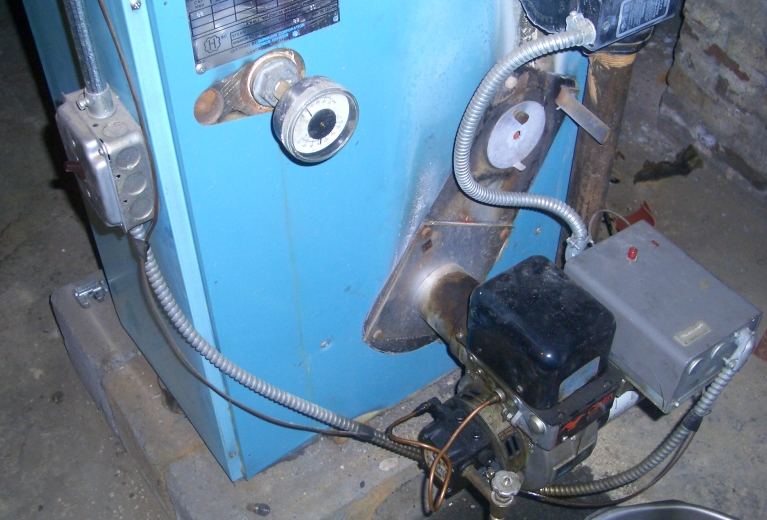
Older oil and solid-fuel heating systems require more frequent maintenance than modern condensing gas boilers.
End-of-season tasks (April – May)
System wind-down
In most of Poland, the heating season ends in April, though in the Podlasie and Warmia-Mazury regions heating may run into May. Once outdoor temperatures consistently stay above 12°C overnight, the boiler can be set to hot water-only mode or turned off in fully equipped modern homes.
End of season checklist
- Check system pressure one final time and top up if below 1.0 bar
- Leave inhibitor in the system — it protects against corrosion and limescale during summer
- For solid fuel systems: clean the firebox and allow the boiler to cool fully before any inspection
- Check all radiator bleed valves are closed — a partially open bleed valve can allow air ingress over summer
- Note any issues observed during the season for the summer service appointment
Smog and fuel quality in Poland
Air quality in Polish cities has been a public health concern, and national and local regulations on heating fuel quality continue to evolve. The 2018 anti-smog regulation (uchwała antysmogowa) adopted in most Polish regions sets minimum quality standards for solid fuels burned in residential boilers. Specific requirements vary by voivodeship — the Małopolskie voivodeship adopted some of the strictest limits in 2019.
For solid fuel boiler owners, using coal or wood that meets current local standards reduces both air pollution and chimney fouling. Information on current standards is available from the regional marshal's office (urząd marszałkowski) or from the Polish Smog Alert (Polski Alarm Smogowy) website.
Heat pump considerations
For homes with air-source heat pumps, manufacturer guidance on annual maintenance typically covers filter cleaning, checking refrigerant levels (requires a certified F-gas engineer), and inspecting outdoor unit clearance. Heat pumps in Poland face specific challenges during cold snaps below -15°C, which occur in the north-east — ensure the system's low-temperature cut-off settings are appropriate for the regional climate.